Critical Thinking (CT) GuideBook

Success With Critical Thinking (CT)

Lesson 1. Success With CT (The Standard)
What Critical Thinking Means

Critical thinking (CT) is a reliable method for deciding what to believe and what to do.

A method is a set of steps for getting a desired result.

Examples (When CT Is Useful)
  • A person reads competing claims about the age of the Earth, 6,000 years versus 4.6 billion years, and wants to decide which is more likely correct.
  • A juror wants to decide correctly whether the accused is guilty.
  • A company wants to decide which marketing plan is best.
  • A shopper wants to determine whether organic food is healthier.
  • A mechanic wants to figure out what is causing an engine noise.
  • An oncologist needs to say which treatment is best for a patient.
  • A homeowner wants to decide which house paint is best.
  • A family wants to figure out whether to pay off the mortgage or invest the money.
  • A group of friends wants to choose the best place for a ski trip.
  • An engineering team wants to figure out the best way to solve a technical problem.

In cases where CT is useful, a person or group wants to get a claim right.

Standard for CT
  1. Explain critical thinking well enough that others can learn to apply it.
  2. Make or accept only claims that are likely to be:
    1. True, for claims about how things are
    2. Right, for claims about values or actions
Lesson 2. Why CT Matters (Rationale)
Reasons for CT
  • Right actions
    • You and your groups raise your odds of taking the right action when you make a choice, solve a problem, or plan, such as the right job, treatment, or plan.
  • True beliefs
    • You and your groups believe more of what’s true and less of what’s false.
  • Not fooled
    • Scams, misinformation, and honest mistakes have less hold on you and your groups.
  • Trusted by others
    • Claims from you and your groups hold up, so others listen when you speak.
Costs and Tradeoffs
  • Time and effort
    • Checking a claim takes longer than accepting it.
  • Discomfort
    • Sometimes you have to accept what you wish weren’t true, take an action you’d rather not take, or say “I don’t know yet.”
  • Standing apart
    • Your groups may believe or do things you don’t. Going your own way can make you an outlier and cost you comfort, standing, or friendships.
  • Can’t check everything
    • You have to pick which claims are worth checking.
When It Matters
  • Every day, many times a day, since you’re always choosing what to believe and do.
  • Most when a lot rides on a claim: your health, money, safety, job, or vote.
  • When a group decides what to do or believe, such as a family, team, company, or country. More people bear the results, and groupthink makes mistakes easier to miss.
  • When someone wants something from you: your money, your trust, or your agreement.
Who It Matters Most To
  • Everyone, since everyone decides what to believe and what to do.
  • Most of all, people whose choices affect others: parents, managers, doctors, jurors, voters, and leaders.
  • Groups that want to make good decisions together: families, teams, companies, and governments.
Lesson 3. Causes of Success (Causal Model)

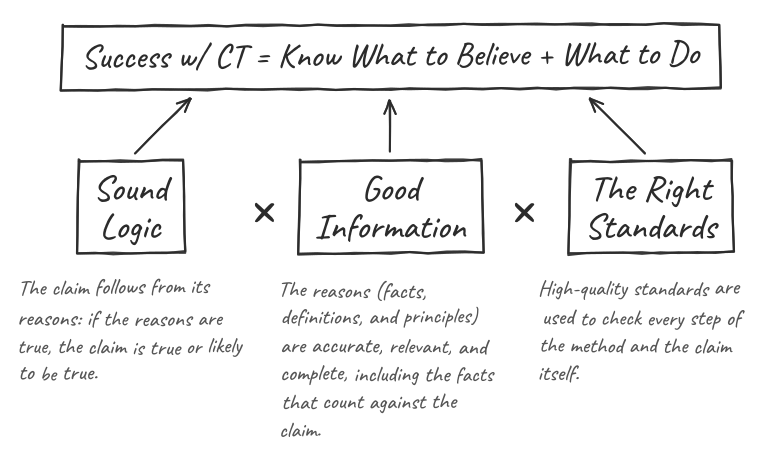
Success with critical thinking means knowing what to believe and what to do. This success is caused by the following three essential causes:

Sound logic

The claim follows from its reasons: if the reasons are true, the claim is true or likely to be true.

Good information

The reasons (facts, definitions, and principles) are accurate, relevant, and complete. Complete includes the facts that count against the claim.

The right standards

High-quality standards are used to check every step of the method and the claim itself.

The Model at a Glance

Figure 3.1 summarizes the causal model. Note that CT gives you probabilities, not certainty: what is most likely true, and which options are most likely best.

Hand-drawn causal model. A top box reads: Success w/ CT = Know What to Believe + What to Do. Arrows point up to it from three boxed causes joined by times signs: Sound Logic (the claim follows from its reasons: if the reasons are true, the claim is true or likely to be true), Good Information (the reasons, which are facts, definitions, and principles, are accurate, relevant, and complete, including the facts that count against the claim), and The Right Standards (high-quality standards are used to check every step of the method and the claim itself).
Figure 3.1. The causal model of success with CT

The next lesson turns these causes into a recipe you can follow.

Lesson 4. Recipe for Success (Process)

Success with CT comes from sound logic, good information, and the right standards. Here is a recipe that puts all three to work. It starts with a question, not a claim, so you don’t settle on an answer before you’ve looked.

  1. Key Question: Frame the key issue as a high-quality question.
  2. Standards: For a T-claim, use the standard for any T-claim. For an S-claim, use the standard for any S-claim, and create or find a high-quality standard for the specific case.
  3. Information: Get high-quality information for answering the key question.
  4. Logic and Argument: Organize the information so that it reveals the answer to the key question and shows, by the rules of inference, that the answer is right.
  5. Evaluation: Compare the conclusion to the appropriate standard for its type of claim (S-claim, T-claim, and so on). Then decide on the best next step, which depends on whether the claim is yours or someone else’s.
Lesson 5. Examples of the Recipe
Example 1 (A Fund That Fell and Rose)

An exam question says, “A fund fell 50% last year and rose 50% this year. What is the net return?”

  1. Key Question: Over the two years, what is the fund’s net return, as a percent of its starting value?
  2. Standards: The answer will be a T-claim, so use the standard for any T-claim. There is no standard to create for this case.
  3. Information: The question gives two facts: the fund fell 50% in year 1 and rose 50% in year 2. You bring one principle: a percent change is a share of the value at the start of that change.
  4. Logic and Argument: Start with 100 dollars. A 50% fall leaves 50 dollars, and a 50% rise on 50 dollars gives 75 dollars, which is 25 dollars less than the start. So over the two years, the fund lost 25% of its starting value.
  5. Evaluation: Judged by the standard for any T-claim, the conclusion holds. The facts are correct and complete: both percentages are given, and the principle is what a percent change means. The answer follows from them: 0.5 × 1.5 = 0.75, so the result is the same for any starting value. The rival answer, “back to even,” fails because it treats both percentages as shares of the same amount, and they aren’t. The claim is yours and it holds, so state it: the net return is a loss of 25%.
Example 2 (A Jury Trial)

You are on a jury. A man is charged with stealing a laptop from his office.

  1. Key Question: Did the accused take the laptop?
  2. Standards: The answer will be a T-claim, so use the standard for any T-claim. There is no standard to create for this case, but the court sets how sure you must be: sure beyond a reasonable doubt.
  3. Information: His badge opened the office door at 7 p.m. A coworker saw him leave that evening carrying a laptop bag, but she saw a bag, not the laptop, and from across a parking lot. He often works late, and he owns a laptop bag. The door log shows that two other people came in that evening. The laptop was never found.
  4. Logic and Argument: The badge record shows that he was there and could have taken the laptop. The door log shows the same for two other people. The bag fits a theft, and it also fits an ordinary evening for someone who carries a laptop bag. Nothing ties the laptop itself to him. So the information doesn’t show, beyond a reasonable doubt, that he took it.
  5. Evaluation: Judged by the standard for any T-claim, the conclusion holds. The facts are reliable, and they include the ones that count against a theft. The conclusion claims no more than the facts show. The rival answer, “he did it,” fails because it takes for granted that nobody else could have, and two other people could. The claim is yours as a juror, so act on it: vote not guilty. If the laptop turned up in his car, you would think again.
Example 3 (Bitcoin or an Index Fund)

You are saving for retirement and have to choose where to put the money. A coworker says Bitcoin beats an index fund.

  1. Key Question: For my retirement savings, which is the better investment, Bitcoin or an index fund?
  2. Standards: The answer will be an S-claim, so use the standard for any S-claim, and find a standard for this case: a good retirement investment grows over decades, with little risk that the money isn’t there when you need it.
  3. Information: Over the past ten years, Bitcoin’s price has grown far more than the stock market. It has also fallen by more than half several times. An index fund spreads your money across hundreds of companies, and Bitcoin is one asset. Nobody knows what either will do over the next thirty years.
  4. Logic and Argument: Compare each choice to the standard. On growth, Bitcoin has done better so far, but past growth doesn’t promise future growth. On risk, the index fund is far safer, because its swings are smaller and it doesn’t depend on one asset. A retirement investment has to do well on both, so the index fund is the better choice.
  5. Evaluation: Judged by the standard for any S-claim, the conclusion holds. The standard for this case fits the purpose, the facts are reliable, and the conclusion comes from comparing both choices to that standard. The rival answer, “Bitcoin is better,” fails because it treats “has grown the most” as the whole standard. The claim is yours, so act on it: put your retirement savings in the index fund. Someone with a different purpose, such as investing money they can afford to lose, would need a different standard and could fairly decide otherwise.
Example 4 (Solar Panels for Your House)

Your electric bill keeps rising, and an installer has given you a quote for solar panels.

  1. Key Question: Should we install solar panels on our house?
  2. Standards: The answer will be an S-claim, so use the standard for any S-claim, and create a standard for this case: the panels should pay for themselves while we own the house.
  3. Information: The installer quotes 18,000 dollars and says the panels will save 1,800 dollars a year. The installer profits from the sale, so you check that figure. Your past bills and a neighbor’s panels point to savings of about 1,500 dollars a year. You expect to stay in the house about 8 years.
  4. Logic and Argument: At 1,500 dollars a year, the panels take 12 years to pay back 18,000 dollars. You expect to own the house for 8 years, and 12 is more than 8. So the panels wouldn’t pay for themselves, and you shouldn’t install them now.
  5. Evaluation: Judged by the standard for any S-claim, the conclusion holds. The standard for this case fits what you care about, the savings figure was checked against sources with nothing to sell, and the arithmetic follows. The rival answer, “install them,” fails because it takes the installer’s figure and a long stay for granted. The claim is yours, so state it no more strongly than its grounds support: “We shouldn’t install solar panels unless we plan to stay at least 12 years.” Then bring it to your family.
More Examples

The same recipe gives results like these.

  • A supplement ad
    • “This pill improves memory” turns out to rest on one small study paid for by the maker, so you withhold judgment and keep your money.
  • Two job offers
    • Once you say what matters most to you, such as pay, growth, or time at home, one offer comes out clearly ahead.
  • A news story
    • “Crime doubles” turns out to mean a rise from 3 cases to 6 in one neighborhood, so you accept the count and reject the alarm.
What the Examples Have in Common
  • Each starts with a question, not a claim.
  • Each follows the same five steps.
  • Each names the type of claim before any information is gathered, so you know what the answer will be judged by. An S-claim also needs a standard for the case.
  • In each, the answer is the conclusion of an argument built from the information.
  • In each, the rival answer failed because of something it took for granted.
  • Each ends with a claim you can act on, held as firmly as the grounds allow.
Lesson 6. Learning the Recipe (The Try-Improve Loop)
The Try-Improve Loop

Nobody gets good at CT by reading about it. You get good by running the recipe many times and improving each time.

  1. Try: Run the recipe on a real claim.
  2. Look back: See how your judgment held up, and find the step where things went wrong.
  3. Improve: Fix that one thing, then run the recipe again on a new claim.

Repeat the loop until you reliably meet the standard.

Tasks With Feedback

A TwF (task with feedback) is a task you attempt, paired with feedback that compares your attempt with a standard.

  • TwFs are how you run the loop: you work through a claim, find your gaps, close them, and repeat until you reliably meet the standard.
  • They show whether you’ve learned: you meet the standard when you can pass the Mastery TwFs on your own, months after you stop practicing.
  • They keep you from fooling yourself. Reading about CT makes it feel easy; a TwF shows whether you can do it.
  • They save time. You work on your gaps, not on what you already know.

TwFs come in four levels, from a first try to the full standard: Basics, Apply, Range, and Mastery.

The rest of this GuideBook teaches you how to run the recipe.

Tasks with Feedback
1. What is critical thinking?
Exemplar

Critical thinking is a reliable method for deciding what to believe and what to do.

Standard
2. CT is a method. What does “method” mean?
Exemplar

A method is a set of steps for getting a desired result.

Standard
3. List 5+ reasons why a medical doctor would want to be skilled at critical thinking.
Exemplar
  1. Avoid bad mistakes, like a wrong diagnosis or the wrong treatment.
  2. Choose the best treatment for each patient, not just the usual one.
  3. Spot weak research and sales pitches, so drug reps and hyped studies don’t sway you.
  4. Earn patients’ trust, so they follow your advice.
  5. Protect lives. Your mistakes cost other people their health, so you must get it right.
  6. Make the best business choices for your practice, such as whom to hire, what to buy, and which insurers to accept.
  7. Handle problems with colleagues and supervisors well, by finding the best way to settle a conflict instead of reacting.
Standard
4. List 5+ reasons why an electrician would want to be skilled at critical thinking.
Exemplar
  1. Avoid fires and shocks caused by misjudging a fault or choosing the wrong fix.
  2. Avoid costly callbacks that come from guessing at a cause instead of testing.
  3. Find the real cause of a problem the first time, so the job gets done right.
  4. Give accurate quotes, so you win jobs and still make money on them.
  5. See through product hype, so you install gear that works, not just what the supplier pushes.
  6. Read the electrical code correctly, so your work passes inspection.
  7. Decide which jobs to take, and when to turn one down.
Standard
5. List 5+ reasons why a college student would want to be skilled at critical thinking.
Exemplar
  1. Avoid wasting years and money on a major or career that doesn’t fit you.
  2. Avoid being fooled by misinformation, scams, and persuasive people on campus.
  3. Get better grades with papers and answers that hold up.
  4. Choose the best major and courses for the life you want.
  5. Learn faster, by checking what you think you know instead of just rereading.
  6. Make wise money choices, such as loans, credit cards, and part-time jobs.
  7. Hold your own in arguments, in class and out.
Standard
6. List 5+ reasons why a parent would want to be skilled at critical thinking.
Exemplar
  1. Avoid health mistakes, like trusting a false claim about food, medicine, or vaccines.
  2. Avoid wasting money on products and programs that promise to make your child smarter or safer.
  3. Choose the best school, doctor, and activities for your child.
  4. Set rules that work, by checking what actually helps kids, not just what feels right.
  5. Settle family conflicts fairly, by hearing each side’s reasons.
  6. Teach your kids to think, by showing them how you decide what to believe.
Standard
7. List 5+ reasons why a citizen would want to be skilled at critical thinking.
Exemplar
  1. Avoid being fooled by propaganda, fake news, and slick campaign ads.
  2. Avoid backing policies that backfire.
  3. Vote for the candidates and measures that best serve what you value.
  4. Judge news stories and statistics, so you know what’s really happening.
  5. Serve well on a jury, so the guilty are convicted and the innocent go free.
  6. Disagree well with neighbors, by trading reasons instead of insults.
Standard
8. List 5+ reasons why a winemaker would want to be skilled at critical thinking.
Exemplar
  1. Avoid ruined batches, by tracing a fault to its real cause, such as the yeast or the temperature.
  2. Avoid costly fads, like equipment or additives that promise more than they deliver.
  3. Make better wine, by testing what actually improves it instead of trusting lore.
  4. Pick the best time to harvest, by weighing sugar, acid, and the weather forecast.
  5. Set the right prices and choose the best markets for your wine.
  6. Make claims about your wine that hold up, so buyers and critics trust you.
Standard
9. List 5+ reasons why an engineer would want to be skilled at critical thinking.
Exemplar
  1. Avoid designs that fail, like a bridge, part, or program that breaks in use.
  2. Avoid trusting bad data, such as a faulty test or a simulation built on wrong assumptions.
  3. Choose the best design, by comparing options against clear requirements.
  4. Find the root cause of a failure, not just its symptoms.
  5. Spot hidden assumptions in a spec, a model, or a vendor’s claim.
  6. Make a convincing case to your team, managers, and clients.
Standard
10. List 5+ reasons why you would want to be skilled at critical thinking, in your own life or work.
Exemplar
  • One high-quality response, from an office manager:
    1. Avoid hiring mistakes, by checking claims on résumés and in interviews.
    2. Avoid being scammed by vendors and phishing emails.
    3. Choose the best software and suppliers for the office.
    4. Fix problems that keep coming back, by finding their real causes.
    5. Settle staff conflicts fairly.
    6. Make sound choices at home about money, health, and family.
Standard
11. In general, why would anyone want to be skilled at critical thinking?
Exemplar
  1. Believe what’s true, and less of what’s false.
  2. Make better choices about work, money, health, and plans.
  3. Avoid being fooled by scams, misinformation, and honest mistakes.
  4. Be trusted, because your claims hold up.
  5. Settle disagreements with reasons, instead of fights.
Standard

Stating an Argument (Claim + Reasons)

Orientation
Where Arguments Fit in CT

Critical thinking gives individuals and groups justified beliefs and wise decisions about what to do. It does this by working with claims and arguments.

A claim is a statement that asserts that something is or is not the case. An argument is a set of claims in which some (the reasons) are offered as support for another (the conclusion).

This part explains how to put arguments into standard form, as illustrated by the following examples.

Someone Else’s Argument
Bedtime

Maya says, “I should get to stay up till 11. All my friends do!” In standard form, her argument is as follows.

Her dad answers with an argument of his own:

Your Own Argument
Garden

You want to grow a garden this year, so you present your argument to your partner:

Reaching Your Own Conclusion
Math Problem

You’re asked, “What is the angle change, in SI units, of the hour hand of a clock as the time changes from 11:00 AM to 11:50 AM?” Your answer, stated as an argument:

Diet

Your doctor suggests that you consider the Mediterranean diet, so you research it and lay out the following argument:

What Standard Form Means

Standard form is a way of writing an argument that states the issue, the conclusion, and each reason on a line of its own.

Some books list the reasons first and put the conclusion last.

Standard for This Part
  1. Explain the standard form of an argument well enough that others can learn to apply it.
  2. Put the argument behind a claim, yours or someone else’s, into standard form, so that it is clear, faithful to what the arguer meant, in neutral words a fair observer would accept, and made up only of reasons aimed at the conclusion.
Why This Part Matters

You can’t judge a claim until you see what it is and what it rests on. Stating the argument puts the question, the claim, and the reasons in plain view, so you judge what was said and not what you assumed.

Lesson 7. Claim
What a Claim Means
Definition

A claim is a statement that asserts that something is or is not the case.

Because of this, a claim makes linguistic sense when you put it in the blank of Is it true that ___? This is called the claim test.

Examples
  • Water boils at 100 °C at sea level.
  • The earth is flat.
  • Our team will win on Saturday.
  • This used car has never been in an accident.
  • Coffee raises your risk of heart disease.
  • I’m too tired to go out tonight.
  • An index fund is a better retirement investment than Bitcoin.
  • You should apologize to your sister.
  • The store is open, and the parking lot is full.
  • If it rains tomorrow, the game will be canceled.
Why This Matters
  • Claims are how people say what is true, what is better or best, and what should be done and by whom.
  • Your beliefs and choices rest on claims, and claims can be false, so spotting them shows you what to check.
Standard for This Lesson
  1. Explain what a claim is, and how it differs from a question, a command, or an exclamation, well enough that others can learn to apply it.
  2. Spot the claims in what you read and hear, such as an ad, a news story, or a conversation, and split each compound claim into its atomic claims.
Meeting the Standard (How To)
Process
  1. Take one sentence at a time: Break what you read or hear into single sentences.
  2. Apply the claim test: Put the sentence in the blank of Is it true that ___? If the result makes sense, the sentence is a claim. If it doesn’t, as with a question, a command, or an exclamation, it isn’t.
  3. Find hidden claims: If a question, command, or exclamation plainly implies a claim, write the claim out as a declarative sentence.
  4. Split compound claims: If a claim joins smaller claims with words such as and, or, or if…then, write out each atomic claim. Then check that, read together with the joining word, they say the same thing as the original.
Key Ideas
  • Declarative sentence: a sentence that says something is so
  • Claim test: a check for whether a sentence is a claim: put it in the blank of Is it true that ___?, and if the result makes sense, the sentence is a claim
  • Non-claims: questions, commands, and exclamations, which can’t be true or false
  • Hidden claim: a claim that a question, command, or exclamation implies without stating it
  • Atomic claim: a claim that makes a single assertion, so it can’t be split into smaller claims
  • Compound claim: a claim made of two or more atomic claims joined by words such as and, or, or if…then
Lesson 8. Key Question
What the Key Question Means

The key question is the main question at issue, which a claim or argument sets out to answer.

Why This Matters

A claim can only be judged against the question it answers, so naming that question keeps you from judging it on the wrong issue.

Standard for This Lesson
  1. Explain the key question, and how it differs from the topic, well enough that others can learn to apply it.
  2. State the question that a claim answers, such as the question behind an ad or a disagreement with a friend, so you judge the claim against the right question.
Meeting the Standard (How To)
Process
  1. Find the main claim: Pick out the claim the speaker most wants you to accept.
  2. Ask what it answers: Name the question this claim is an answer to.
  3. Make it one specific question: Narrow a topic to a single question that has a definite answer.
  4. Check the fit: The claim answers the question directly, and each side of a disagreement would agree it’s the question at issue.
Key Ideas
  • Claim: a statement that can be true or false
  • Topic: a subject, not a question; it has no answer
Lesson 9. Argument
What an Argument Means

An argument is a set of claims in which some (the reasons, also called premises) are offered as support for another (the conclusion).

Why This Matters

Most claims come with reasons, and seeing the argument shows you what the claim rests on, so you can check that and not just the claim.

Standard for This Lesson
  1. Explain what an argument is, and how it differs from a quarrel, well enough that others can learn to apply it.
  2. Find the argument behind a claim and pick out its reasons and conclusion, even when the conclusion comes first or isn’t marked.
Meeting the Standard (How To)
Process
  1. Find the conclusion: Ask what the arguer wants you to accept.
  2. Find the reasons: Ask what they offer in its support.
  3. Check the direction: Each reason supports the conclusion, not the other way around.
Key Ideas
  • Claim: a statement that can be true or false
  • Conclusion: the claim the arguer wants you to accept
  • Reason: a claim offered in support of the conclusion; also called a premise
  • Indicator words: words such as so and because that mark a conclusion or a reason, when there are any
  • Quarrel: a clash of views with no reasons offered
Lesson 10. Reason
What a Reason Means

A reason is a claim offered as an answer to the question, “Why believe the conclusion?”

Why This Matters

Only reasons support a conclusion, so separating them from the rest keeps you from being swayed by background, repetition, or a good story.

Standard for This Lesson
  1. Explain what a reason is, and how it differs from background, a restatement of the conclusion, and the story of how someone came to believe it, well enough that others can learn to apply it.
  2. Pick out the reasons in an argument, and leave out everything that isn’t one.
Meeting the Standard (How To)
Process
  1. State the conclusion first: Know what the reasons must support.
  2. Test each sentence: Ask whether it answers “Why believe the conclusion?”
  3. Keep or leave out: Keep it if it does. Leave it out if it’s background, a restatement, or the story of how the arguer came to believe it.
Key Ideas
  • Background: sets the scene but gives no support
  • Restatement: says the conclusion again in other words
  • Origin story: how someone came to believe the conclusion, not why it’s true
  • Justification: the set of reasons given for a conclusion
Lesson 11. Standard Form
What Standard Form Means

Standard form is a way of writing an argument that states the key question, the conclusion, and each reason on a line of its own.

Why This Matters

In standard form, an argument shows at a glance what is claimed and why, so gaps and weak reasons have nowhere to hide.

Standard for This Lesson
  1. Explain standard form well enough that others can learn to apply it.
  2. Write an argument in standard form, so that a reader sees at a glance what is claimed and why.
Meeting the Standard (How To)
Process
  1. Question: State the key question as a single question.
  2. Conclusion: State one claim that answers it.
  3. Reasons: List each reason as a separate claim on its own line, in plain words.
  4. Cut the rest: Leave out background, restatements, and the story of how the arguer came to believe it.
  5. Read it cold: Check that a reader who hasn’t seen the original sees what is claimed and why.
Key Ideas
  • Key Question: the question the argument answers
  • Conclusion: the claim that answers it
  • Reason: a claim that answers “Why believe the conclusion?”
Lesson 12. Stating Someone Else’s Argument
What Stating Someone Else’s Argument Means

Stating someone else’s argument is putting it into standard form so that it says what the arguer meant.

Why This Matters

When you state an argument as the arguer meant it, you judge what they really said, and they’ll listen when you answer it.

Standard for This Lesson
  1. Explain stating someone else’s argument, and how it differs from restating it in a weaker form, well enough that others can learn to apply it.
  2. State the argument in an ad, an article, or a conversation so that the arguer would agree it is theirs, recording only what they said.
Meeting the Standard (How To)
Process
  1. Record what they said: Note the claim and the reasons the arguer gave, and add nothing they didn’t say.
  2. Put it in standard form: Write it out as in Standard Form.
  3. Choose the strongest reading: Where the wording is unclear, pick the reading that makes the argument strongest.
  4. Check it’s theirs: Ask the arguer if you can; if not, check each line against their words.
Key Ideas
  • Faithful: says what the arguer meant
  • Principle of charity: where the wording allows more than one reading, choose the strongest
  • Straw man: a weaker version of the argument, put in place of the real one

Classifying a Claim

Orientation
What Classifying a Claim Means

Classifying is putting something into a group based on characteristics it shares with the other members. People do it everywhere: a doctor classifies an illness as viral or bacterial, a bank classifies a loan as low or high risk, and you sort laundry into whites and colors. In each case, the group tells you how to handle the thing: which treatment, what interest rate, which wash cycle.

In CT, classifying a claim is naming its type, then its sub-type. There are two types:

  1. T-claim (truth claim): a claim about how things are. It is true or false, and its truth value is the same for everyone.
  2. S-claim (standards claim): a claim that something meets a standard. It is also true or false, but only once a standard is chosen. Since people can choose different standards, they can disagree about an S-claim in ways that make sense.
Standard for This Part
  1. Explain claim classification well enough so that others can learn this.
  2. Classify any claim as a T-claim or an S-claim, and then by sub-type
    1. Definition type or evidence type for a T-claim
    2. Value type or action type for an S-claim.
Why This Part Matters
  1. CT is deciding which claims to accept.
  2. Each claim is evaluated based on its type (T or S).
  3. Thus, classifying a claim tells you which method to use to evaluate it.
Lesson 13. T-Claims
What T-Claims Mean
Definition

A T-claim (truth claim) is a claim that is either true for everyone or false for everyone.

Analysis of the Definition
True for everyone or false for everyone

Whether it’s true doesn’t change with who judges it.

Not the same as true, known, or agreed on

A T-claim can be false, unknown, or hotly disputed and still be a T-claim.

Examples
  • The earth is round. (science)
  • The earth is about 4.5 billion years old. (science)
  • A #10 machine screw has a major diameter of 0.190 inches. (engineering)
  • The defendant took the laptop. (a courtroom; maybe only the defendant knows, but it’s true or false for everyone)
  • Humans landed on the Moon in 1969. (history; some people deny it, but that doesn’t change its type)
  • A square has four sides. (definitions)
  • The Moon is made of green cheese. (false, but still a T-claim)
  • It will rain in Seattle tomorrow. (a prediction; no one knows yet)
Non-Examples
  • Movie M is excellent. (an S-claim: it depends on the judge’s standard for an excellent movie)
  • You should take the job. (an S-claim)
  • Is the earth round? (a question, not a claim)
Why This Matters
  • You know how to settle it: with logic or evidence, not with anyone’s taste.
  • A disagreement has an answer: if two people disagree about a T-claim, at least one of them is wrong, so it’s worth finding out who.
    • “Agree to disagree” and “that’s just your opinion” don’t fit a T-claim.
  • You can often look it up: many T-claims have been checked by people who study them, such as doctors, engineers, and historians, so you can check what they found instead of arguing.
Standard for This Lesson
  1. Explain T-claims well enough that others can learn to apply them.
  2. Say whether a claim you read or hear, such as a news headline or a friend’s remark, is a T-claim, in clear cases.
Meeting the Standard (How To)
Process
  1. Check that it’s one claim: If it’s compound, split it first, as in Claim.
  2. Apply the two-judge test: Picture two careful people who know all the facts and use the words the same way. If they would have to agree on whether it’s true, it’s a T-claim.
  3. Ignore what doesn’t count: whether the claim is true, known, proven, or agreed on, and how confident it sounds.
Key Ideas
  • T-claim: a claim that is either true for everyone or false for everyone
  • Two-judge test: could two careful people who know all the facts and use the words the same way still disagree without either being wrong? If not, it’s a T-claim.
  • Atomic claim: a claim that makes a single assertion
Common Mistakes
  • Thinking a T-claim must be true: false claims are T-claims too.
  • Thinking a T-claim must be known or proven: “The defendant took the laptop” is a T-claim even if no one can prove it.
  • Thinking a disputed claim can’t be a T-claim: disagreement shows that a claim is disputed, not that its truth depends on the judge.
  • Judging by tone: a claim that sounds confident or factual isn’t a T-claim for that reason.
Lesson 14. S-Claims
What S-Claims Mean
Definition

An S-claim (standards claim) is a claim that something meets a standard, where the standard is up to whoever judges the claim.

Analysis of the Definition
Standard

What counts as good enough for something, such as what makes a movie excellent or a job offer good.

Up to whoever judges the claim

The claim doesn’t name its standard, so each judge supplies one, often without saying so.

So an S-claim can be true for one person and false for another, and both can be judging fairly.

Still true or false once a standard is chosen

“Movie M meets my standard for an excellent movie” can be checked.

Examples
  • Movie M is excellent. (It meets the speaker’s standard for an excellent movie.)
  • Vanilla tastes better than chocolate.
  • This is a good job offer.
  • The water is safe to drink. (By whose standard of safe: the EPA’s, the WHO’s, a cautious parent’s?)
  • That car is too expensive.
  • Plan A is the best plan.
  • You should take the job.
  • We shouldn’t install solar panels.
Non-Examples
  • Most critics rated movie M excellent. (a T-claim: it reports what critics think)
  • The water meets the EPA limit for lead. (a T-claim: it names its standard)
  • The earth is round. (a T-claim)
Why This Matters
  • You know to find the standard first: an S-claim can’t be checked until you know which standard it’s judged by, so you ask, “By what standard?”
  • You stop arguing about the wrong thing: many disagreements are about standards, not facts. Two people can agree on every fact and still disagree.
  • You can disagree fairly: someone who reaches a different S-claim may have a different purpose, not worse facts.
    • Example: someone investing money they can afford to lose can fairly pick a different investment than someone saving for retirement.
  • But not anything goes: once the standard is named, the claim can be checked, and the standard itself can be judged by whether it fits the purpose.
Standard for This Lesson
  1. Explain S-claims well enough that others can learn to apply them.
  2. Say whether a claim is an S-claim, in clear cases, and name the kind of standard it rests on, even when the speaker leaves it unstated.
Meeting the Standard (How To)
Process
  1. Check that it’s one claim: If it’s compound, split it first, as in Claim.
  2. Apply the two-judge test: If two careful people who know all the facts and use the words the same way could still disagree without either being wrong, it’s an S-claim.
  3. Find the standard: Ask “By what standard?” and restate the claim as “X meets the standard for ___,” such as “Movie M meets my standard for an excellent movie.”
Key Ideas
  • S-claim: a claim that something meets a standard, where the standard is up to whoever judges the claim
  • Standard: what counts as good enough for something
  • Two-judge test: see T-Claims
  • Value words: words such as good, best, too, should, and ought, which often mark an S-claim, but not always (see T-Claim or S-Claim?)
Common Mistakes
  • Thinking an S-claim is “just opinion” and can’t be judged: once its standard is named, it can be checked.
  • Stating your S-claim as a T-claim: “It’s a fact that this is the best phone” treats your standard as everyone’s.
  • Arguing facts when the disagreement is about standards: more facts won’t settle it until the standard is agreed.
  • Missing an S-claim with no obvious value word: “This car is too expensive” rests on a standard for price.
Lesson 15. T-Claim or S-Claim?
What Telling T-Claims From S-Claims Means

Most claims are easy to sort. This lesson is about the ones that aren’t.

Definition

Telling T-claims from S-claims is sorting each atomic claim into one type or the other, including claims that look like the other type.

Examples
  • “Most voters think the tax is unfair” is a T-claim. It reports what voters think.
  • “The water meets the EPA limit for lead” is a T-claim, but “The water is safe to drink” is an S-claim.
  • “Objectively, this is the best restaurant in town” is an S-claim. Saying objectively doesn’t name a standard.
  • “The drug lowers blood pressure, and you should take it” is a T-claim joined to an S-claim. Split it, then sort each part.
Why This Matters
  • The type picks the method: sort a claim wrong and you judge it by the wrong standard. You look for evidence where a standard is needed, or treat a fact as a matter of taste.
  • You see what a disagreement is about: facts, standards, or both.
  • You aren’t fooled by wording: ads and arguments dress S-claims as facts (“experts agree it’s the best”) and T-claims as opinions (“that’s just your view of the data”).
Standard for This Lesson
  1. Explain how to tell T-claims from S-claims well enough that others can learn to apply it.
  2. Classify any claim as a T-claim or an S-claim, including look-alikes such as reports of values, claims that name their standard, and compound claims that mix the two.
Meeting the Standard (How To)
Process
  1. Split it: If the claim is compound, split it into atomic claims, as in Claim, and sort each one.
  2. Ask whether it’s a T-claim: Apply the two-judge test from T-Claims.
  3. Check the look-alikes: Compare the claim to the look-alikes below before you settle.
  4. Sort it: If it’s a T-claim, you’re done. If it isn’t, it’s an S-claim.
Look-Alikes
Reports of values (T)

“Most voters think the tax is unfair” reports what voters think, which is true or false for everyone.

Claims that name their standard (T)

“The water meets the EPA limit for lead.” The standard is chosen in the claim, not by the judge. Compare “The water is safe to drink” (S).

Value words that state a fact (T)

“Smoking is bad for your lungs” means smoking damages the lungs.

Facts people fight about (T)

“The defendant took the laptop.” Disagreement doesn’t make it an S-claim.

Predictions (T)

“The stock will rise next year.” No one knows yet, but it will be true or false for everyone.

Opinions dressed as facts (S)

“Objectively, this is the best restaurant in town.” “It’s a fact that…” and “objectively” don’t name a standard.

Hidden standards (S)

“This car is too expensive.” Too means it fails someone’s standard for price.

Mixed compound claims (split)

“The drug lowers blood pressure, and you should take it.” One T-claim and one S-claim.

Key Ideas
  • T-claim: a claim that is either true for everyone or false for everyone
  • S-claim: a claim that something meets a standard, where the standard is up to whoever judges the claim
  • Look-alike: a claim that looks like one type but is the other
  • Atomic claim: a claim that makes a single assertion
Common Mistakes
  • Sorting by value words alone: “Smoking is bad for your lungs” has a value word and is a T-claim.
  • Sorting by whether people disagree: people fight about T-claims too.
  • Sorting a compound claim as a whole: split it first.
  • Trusting labels like objectively or it’s a fact that: they change the tone, not the type.
Lesson 16. Definition and Evidence T-Claims
What Definition and Evidence T-Claims Mean
Definition

A definition-type T-claim is one that definitions and logic alone can settle; an evidence-type T-claim is one that only evidence about the world can settle.

Analysis of the Definition
Definitions and logic alone

You could settle it at a desk, without looking at the world.

Evidence about the world

Observations, measurements, records, and testimony.

Examples
  • Definition type
    • A square has four sides.
    • A fund that falls 50% and then rises 50% is down 25%.
    • A #10 machine screw has a major diameter of 0.190 inches. (The standard that defines a #10 screw sets this.)
    • If all mammals breathe air and whales are mammals, then whales breathe air.
  • Evidence type
    • The earth is about 4.5 billion years old.
    • The screw in this bin has a major diameter of 0.190 inches. (You have to measure it.)
    • The defendant took the laptop.
    • All swans are white. (It sounds like a definition, but it takes evidence, and it’s false: there are black swans.)
Why This Matters
  • It tells you the method: check the logic of a definition-type claim; weigh the evidence for an evidence-type claim.
  • It tells you how sure you can be: a definition-type claim whose logic checks out is certain. An evidence-type claim can only be likely, so you hold it as firmly as its evidence supports.
  • You don’t demand proof where only evidence will do, and you don’t settle for evidence where proof is possible.
Standard for This Lesson
  1. Explain definition-type and evidence-type T-claims well enough that others can learn to apply them.
  2. Name the sub-type of any T-claim, and say whether it can be certain or only likely.
Meeting the Standard (How To)
Process
  1. Confirm it’s a T-claim: Sort it as in T-Claim or S-Claim?.
  2. Ask the desk question: Could you settle it with definitions and logic alone, without looking at the world? If yes, it’s definition type. If no, it’s evidence type.
  3. Set your confidence: certain for a definition-type claim whose logic checks out; likely, never certain, for an evidence-type claim.
Key Ideas
  • Definition type: a T-claim that definitions and logic alone can settle
  • Evidence type: a T-claim that only evidence about the world can settle
  • Desk question: could you settle it without looking at the world?
  • Evidence: observations, measurements, records, and testimony that bear on a claim
Common Mistakes
  • Treating a general claim as definition type: “All swans are white” is about the world, so it takes evidence.
  • Treating a claim about one thing as definition type because a definition covers its kind: “A #10 screw is 0.190 inches” is definition type; “This screw is 0.190 inches” is evidence type.
  • Claiming certainty for an evidence-type claim: “It’s proven that…” usually overstates it.
  • Thinking definition-type claims are too easy to get wrong: most people get the fund example wrong.
Lesson 17. Value and Action S-Claims
What Value and Action S-Claims Mean
Definition

A value-type S-claim rates how good something is; an action-type S-claim says what someone should do.

Analysis of the Definition
Rates how good something is

Good, bad, better, best, excellent, lousy, too expensive.

Says what someone should do

Should, ought, must, or a command that implies one (“Wear a helmet”).

An action claim rests on a value claim

“We should do X” claims that X is the best of the options for some goal.

Examples
  • Value type
    • Movie M is excellent.
    • The index fund is a better retirement investment than Bitcoin.
    • Honesty is better than deceit.
    • That car is too expensive.
  • Action type
    • Put your retirement savings in the index fund.
    • We shouldn’t install solar panels unless we plan to stay at least 12 years.
    • You should exercise three times a week.
    • Wear a helmet when you bike.
Why This Matters
  • Each needs different checks: a value claim needs a standard for the case; an action claim also needs the real options and the facts about each.
  • You find the claim behind the claim: most action claims rest on a value claim, and checking it shows where you agree and where you don’t.
  • You catch a push to act: ads and advice often state an action claim and skip the comparison it rests on.
Standard for This Lesson
  1. Explain value-type and action-type S-claims well enough that others can learn to apply them.
  2. Name the sub-type of any S-claim, and for an action claim, state the value claim it rests on.
Meeting the Standard (How To)
Process
  1. Confirm it’s an S-claim: Sort it as in T-Claim or S-Claim?.
  2. Ask what it does: If it rates something, it’s value type. If it tells someone what to do, it’s action type.
  3. For an action claim, find the value claim behind it: Restate it as “X is the best of our options for goal G.”
Key Ideas
  • Value type: an S-claim that rates how good something is
  • Action type: an S-claim that says what someone should do
  • Options: the real choices an action claim is compared against
  • Standard for the case: the standard an S-claim is judged by in this case
Common Mistakes
  • Sorting by grammar: “You’d be better off renting” is worded as a rating but tells you what to do, so it’s action type.
  • Missing an action claim in a command or question: “Why not buy the extended warranty?” says you should.
  • Checking only the value claim behind an action claim: the best option on paper may not be possible, or may cost too much to switch to.
Lesson 18. Normative and Non-Normative Claims
What Normative and Non-Normative Claims Mean
Definition

A normative claim is a claim about what is good or what should be done; a non-normative claim is a claim about how things are, apart from what anyone values. They are close to S-claims and T-claims.

Other Names
This GuideBook Other names you’ll meet
T-claim non-normative, descriptive, factual, objective
S-claim normative, subjective, opinion, value judgment
Definition type conceptual, analytic
Evidence type empirical
Value type evaluative
Action type prescriptive, policy claim
Why This Matters
  • You can use what others write: books, articles, and other CT courses use these terms instead of T-claim and S-claim.
  • You catch loose matches: some of these terms don’t mean quite what a T-claim or S-claim does, and mixing them up leads to wrong sorting.
Standard for This Lesson
  1. Explain normative and non-normative claims well enough that others can learn to apply them.
  2. When a source uses one of these terms, say which type of claim it means, and notice when the match is loose.
Meeting the Standard (How To)
Process
  1. Translate the term: Find it in the table of other names.
  2. Sort the claim yourself: Sort it as in T-Claim or S-Claim?.
  3. Flag a loose match: If your sort and the source’s term disagree, go by your sort, and note how the source uses the term.
Key Ideas
  • Normative claim: another name for an S-claim
  • Non-normative claim: another name for a T-claim, also called descriptive
Common Mistakes
  • Reading fact as T-claim: many people use fact only for true claims, but a false T-claim is still a T-claim.
  • Reading opinion as S-claim: “In my opinion, it’ll rain tomorrow” is a T-claim that isn’t known yet.
  • Reading subjective as S-claim: “I’m in pain” is about a feeling, but it’s true or false for everyone, so it’s a T-claim.

Checking Logic

Orientation
What Checking Logic Means

Checking logic is determining whether a conclusion follows from its premises.

Standard for This Part
  1. Explain checking logic, and how it differs from judging whether the premises are true, well enough that others can learn to apply it.
  2. Check whether a definition-type T-claim, such as “a fund that falls 50% and then rises 50% is back to even,” follows from definitions and given facts, well enough to say whether it must be true, and know where to turn, such as a logic guidebook or Hurley’s A Concise Introduction to Logic, when Modus Ponens isn’t enough.
Why This Part Matters

Some claims can be settled for certain by logic alone. When you can check the logic, you don’t accept conclusions that don’t follow, the conclusions you put forward are backed by their premises, and you get the fun of working out what follows.

Lesson 19. Logic
What Logic Means

Logic is the study of the principles that determine whether conclusions follow from premises.

Why This Matters

Knowing what logic can and can’t settle keeps you from looking for proof where only evidence or a standard can decide, and from missing it where logic can.

Standard for This Lesson
  1. Explain logic well enough that others can learn to apply it.
  2. Tell when logic alone settles a claim (definition-type T-claims) and when the claim goes to evidence or a standard for its type.
Meeting the Standard (How To)
Process
  1. Name the sub-type: Use Definition and Evidence T-Claims.
  2. Ask what settles it: If definitions and given facts alone fix the answer, logic settles the claim.
  3. Route the rest: Otherwise, the claim goes to evidence or a standard, and logic supplies only the last step.
Key Ideas
  • Argument: reasons (premises) offered as support for a conclusion
  • Rule of inference: a pattern that lets you draw a conclusion from premises, such as Modus Ponens
  • Last step: the step in every evaluation where logic draws the verdict from the standard and the facts (see The Pattern of an Evaluation)
Lesson 20. Modus Ponens
What Modus Ponens Means

Modus Ponens is the rule of inference that from “if A, then B” and “A,” you may conclude “B.”

Why This Matters

Modus Ponens is the rule behind most conclusions you draw, including the last step of every evaluation, so using it well keeps your conclusions sound.

Standard for This Lesson
  1. Explain Modus Ponens, and how it differs from affirming the consequent (“if A, then B; B; so A”), well enough that others can learn to apply it.
  2. Use Modus Ponens to show that a conclusion follows from its premises, and spot arguments that only look like it.
Meeting the Standard (How To)
Process
  1. List the parts: Write the premises and the conclusion in standard form.
  2. Find the conditional: Pick out the premise of the form “if A, then B.”
  3. Check the other premise: It must state A.
  4. Check the conclusion: It must state B. If the argument has B and concludes A, it affirms the consequent, and the conclusion doesn’t follow.
Key Ideas
  • Conditional: a claim of the form “if A, then B”
  • Antecedent and consequent: the A and the B of a conditional
  • Affirming the consequent: “if A, then B; B; so A,” which looks like Modus Ponens but doesn’t follow
Lesson 21. Validity
What Validity Means

An argument is valid when its conclusion must be true if its premises are true.

Why This Matters

A valid argument carries the truth of its premises to its conclusion, so checking validity tells you whether checking the premises is enough.

Standard for This Lesson
  1. Explain validity, and how it differs from soundness (valid with true premises), well enough that others can learn to apply it.
  2. Judge whether an argument is valid.
Meeting the Standard (How To)
Process
  1. Grant the premises: Assume they are true, and set aside whether they really are.
  2. Try to break it: Look for a case where every premise holds and the conclusion is false.
  3. Decide: If such a case is possible, the argument is invalid; if not, it’s valid.
Key Ideas
  • Valid: the conclusion must be true if the premises are
  • Sound: valid, with every premise true
  • Invalidating case: a case with true premises and a false conclusion, which shows an argument is invalid
Lesson 22. Assumption (Unstated Premise)
What an Assumption Means

An assumption is a premise that an argument relies on but doesn’t state.

Why This Matters

Arguments often rest on premises nobody states, and the unstated one is often the weakest, so finding it shows you what really needs checking.

Standard for This Lesson
  1. Explain what an assumption is well enough that others can learn to apply it.
  2. Spot the assumptions an argument depends on, in your own arguments and in others’.
Meeting the Standard (How To)
Process
  1. State the argument: Put it in standard form.
  2. Find the gap: Ask what else would have to be true for the conclusion to follow.
  3. Write it in: Add it as a premise, no stronger than it needs to be to close the gap.
  4. Flag it: Mark it as a premise to check, since no one has stated or defended it.
Key Ideas
  • Assumption: a premise the argument needs but doesn’t state
  • Gap: a step from the stated premises to the conclusion that doesn’t follow on its own
Lesson 23. Definition
What a Definition Means

A definition is a statement of what a term means.

Why This Matters

A claim’s key terms decide what it says, so defining them makes the claim clear and keeps people from arguing past each other.

Standard for This Lesson
  1. Explain what a definition is well enough that others can learn to apply it.
  2. Make a claim clear by defining its key terms, such as what “net return” means in a claim about a fund.
Meeting the Standard (How To)
Process
  1. Find the key terms: Pick out the words the claim turns on.
  2. Define each: State in one plain sentence what it means in this claim.
  3. Check the fit: The definition takes in the cases it should and leaves out the ones it shouldn’t.
Key Ideas
  • Key term: a word whose meaning decides what a claim says
  • Too broad or too narrow: a definition that takes in cases it shouldn’t, or leaves out cases it should
  • Arguing past each other: disagreeing because a key term means different things to each side
Lesson 24. Deriving a Claim From Definitions
What Deriving a Claim From Definitions Means

Deriving a claim from definitions is showing, step by step, that it follows from definitions and given facts by logic.

Why This Matters

When definitions and given facts settle a claim, deriving it gives you a certain answer instead of a guess.

Standard for This Lesson
  1. Explain deriving a claim from definitions well enough that others can learn to apply it.
  2. Derive a claim, or show that it can’t be derived, such as the net return of a fund that falls 50% and then rises 50%.
Meeting the Standard (How To)
Process
  1. List the givens: Write down the definitions and given facts.
  2. State the target: Write the claim you want to reach.
  3. Take one step at a time: Draw each step from the givens or earlier steps by a rule of inference, such as Modus Ponens.
  4. Finish: Reach the claim, or show it can’t be reached, such as with a counterexample.
Key Ideas
  • Definition: a statement of what a term means
  • Derivation: a chain of steps, each following by a rule from the givens or earlier steps
Lesson 25. Counterexample
What a Counterexample Means

A counterexample is a single case that shows a general claim is false.

Why This Matters

One counterexample is enough to show that a general claim is false, which makes it the quickest way to test one.

Standard for This Lesson
  1. Explain what a counterexample is well enough that others can learn to apply it.
  2. Test a definition-type claim by looking for a counterexample, such as starting with 100 dollars to test “a 50% fall and a 50% rise bring you back to even.”
Meeting the Standard (How To)
Process
  1. State the general claim: Write it as “every case that meets these conditions has this result.”
  2. Pick a test case: Choose a simple case that meets the conditions.
  3. Check the result: See whether the claim holds for it.
  4. Decide: If it fails, the general claim is false. If it holds, you’ve tested one case, not proven the claim.
Key Ideas
  • General claim: a claim about every case of a kind
  • Test case: a case that meets the claim’s conditions
  • One case isn’t proof: a case that fits doesn’t show a general claim is true

Evaluating a Claim

Orientation
What Evaluating a Claim Means

Evaluating a claim is judging how likely it is to be true.

Standard for This Part
  1. Explain evaluating a claim well enough that others can learn to apply it.
  2. Evaluate any claim by the method for its type, well enough to accept it, withhold judgment, or reject it as its grounds warrant.
Why This Part Matters

Evaluating is what decides what you believe and what you do. When you can judge how likely a claim is to be true, you believe more of what’s true, you choose better, and you are harder to fool.

Definition-type T-claims are settled by logic alone, so Checking Logic covers them. This part builds on it and covers evidence-type T-claims and S-claims.

Lesson 26. The Pattern of an Evaluation
What the Pattern of an Evaluation Means

The pattern of an evaluation is the form that every evaluation shares: a deductive argument in which one reason must be checked against definitions, evidence, or a standard, depending on the type of claim.

Why This Matters

Every evaluation has the same shape, so once you know the pattern, you know what to check for any claim.

Standard for This Lesson
  1. Explain the pattern of an evaluation well enough that others can learn to apply it.
  2. Lay out the evaluation of any claim in this pattern, and say which reason needs checking and what to check it against.
Meeting the Standard (How To)
Process
  1. Name the claim and its sub-type: Use Definition and Evidence T-Claims or Value and Action S-Claims.
  2. First premise: If the claim meets the standard for its type, it is true, or likely true.
  3. Second premise: The claim meets that standard.
  4. Conclusion: By Modus Ponens, the claim is true, or likely true.
  5. Check the second premise: It is the reason that needs checking, against definitions, evidence, or a standard, as the sub-type calls for.
Key Ideas
  • Standard for the claim’s type: the Standard for Any T-Claim or the Standard for Any S-Claim
  • What to check against: definitions for a definition-type T-claim, evidence for an evidence-type T-claim, and a standard for the case for an S-claim
Lesson 27. Probability
What Probability Means

Probability is how likely a claim is to be true, from 0 (certainly false) to 1 (certainly true).

Why This Matters

Few claims are certainly true or false, so saying how likely a claim is lets you match your belief to its grounds instead of forcing a yes or no.

Standard for This Lesson
  1. Explain probability well enough that others can learn to apply it.
  2. Estimate how likely a claim is to be true and state it as a probability.
Meeting the Standard (How To)
Process
  1. Gather the grounds: Collect what bears on the claim.
  2. Place it on the scale: 0 is certainly false, 0.5 is as likely as not, and 1 is certainly true.
  3. State it: Give a number, or a range when you can’t be precise.
  4. Match your words: Use words that fit the number, such as probably or almost certainly.
Key Ideas
  • Probability scale: from 0 (certainly false) to 1 (certainly true)
  • Range: a span of probabilities, for when you can’t be precise
  • Calibrated: stated with the confidence the grounds support
Lesson 28. Required Probability
What the Required Probability Means

The required probability is the bar you set for how likely a claim must be before you accept it.

Why This Matters

Setting the bar before you look keeps you from accepting a risky claim on thin grounds, and from demanding certainty when little is at stake.

Standard for This Lesson
  1. Explain the required probability, and how it differs from the probability of the claim, well enough that others can learn to apply it.
  2. Set the required probability for a case, higher when more rides on being wrong, such as “beyond a reasonable doubt” in a trial.
Meeting the Standard (How To)
Process
  1. Cost of a false yes: Ask what happens if you accept the claim and it’s false.
  2. Cost of a false no: Ask what happens if you reject it and it’s true.
  3. Set the bar: Set it higher the more a false yes would cost.
  4. Set it first: Fix the bar before you weigh the evidence.
Key Ideas
  • Probability: how likely the claim is to be true
  • Required probability: the bar the claim must clear before you accept it
  • Stakes: what rides on being wrong
Lesson 29. Withholding Judgment
What Withholding Judgment Means

Withholding judgment is declining to accept or reject a claim until there are better grounds.

Why This Matters

Withholding judgment when the grounds are weak keeps you from believing too soon and from rejecting too soon.

Standard for This Lesson
  1. Explain withholding judgment, and how it differs from rejecting a claim, well enough that others can learn to apply it.
  2. Withhold judgment when the grounds for a claim are too weak to accept or reject it.
Meeting the Standard (How To)
Process
  1. Compare with the bars: Ask whether the claim clears the bar for accepting it, and whether its denial clears the bar for rejecting it.
  2. If neither clears: Say you don’t know yet.
  3. Name what would settle it: Note the information that would move you.
Key Ideas
  • Withholding judgment: neither accepting nor rejecting a claim
  • Rejecting: accepting that a claim is false, which takes grounds of its own
  • Required Probability: the bar for accepting
Lesson 30. Deciding on a Claim
What Deciding on a Claim Means

Deciding on a claim is choosing, after evaluating it, to accept it, reject it, or withhold judgment.

Why This Matters

An evaluation pays off only when it ends in a decision you can act on, and saying what would change it keeps you open to new information.

Standard for This Lesson
  1. Explain deciding on a claim well enough that others can learn to apply it.
  2. Decide on a claim once you have evaluated it, and say what new information would change your decision.
Meeting the Standard (How To)
Process
  1. Get the probability: Take it from your evaluation of the claim.
  2. Compare with the bar: Use the required probability.
  3. Decide: Accept the claim if it clears the bar, reject it if its denial does, and otherwise withhold judgment.
  4. Note what would change it: Name the new information that would change your decision.
Key Ideas
Lesson 31. Information
What Information Means

Information is the facts, definitions, and principles that bear on the answer to a key question.

Why This Matters

An answer can be no better than the information behind it, so getting good information is where a sound claim starts.

Standard for This Lesson
  1. Explain information well enough that others can learn to apply it.
  2. Get the information a key question needs, and judge whether it is high-quality.
Meeting the Standard (How To)
Process
  1. List what the question needs: Name the facts, definitions, and principles that bear on the answer.
  2. Get each one: Find it in a source you can rely on.
  3. Check its quality: It is accurate, relevant, and enough, including what counts against the answer you expect.
Key Ideas
  • Facts, definitions, and principles: the three kinds of information
  • High-quality information: accurate, relevant, and enough
  • Source Reliability: how far a source can be trusted
Lesson 32. Standard
What a Standard Means

A standard is a description of what is most desirable in something.

Why This Matters

Every value or action claim is judged against a standard, so stating the standard shows what the claim rests on and where people disagree.

Standard for This Lesson
  1. Explain what a standard is well enough that others can learn to apply it.
  2. State the standard behind a value or action claim, such as what makes one job offer better than another.
Meeting the Standard (How To)
Process
  1. Name the thing and its purpose: Say what it is and what it’s for.
  2. Ask what would make it best: Ask what it would be like at its best for that purpose.
  3. List the qualities: Write a short list, each a quality you could check.
  4. Check the list: Nothing important is missing, and nothing on it doesn’t matter.
Key Ideas
  • Criterion: one quality in a standard
  • Purpose: what the thing is for, which decides what counts as best
Lesson 33. Standard for Any T-Claim
What the Standard for Any T-Claim Means

The standard for any T-claim is a description of what is most desirable in a T-claim, whatever it is about.

Why This Matters

One standard applies to every T-claim, whatever it is about, so learning it once gives you a check for any claim about how things are.

Standard for This Lesson
  1. Explain the standard for any T-claim well enough that others can learn to apply it.
  2. Judge a T-claim against the standard for any T-claim, such as the answer to an exam question or the charge in a jury trial.
Meeting the Standard (How To)
Process
  1. Clear: The claim and its key terms say one thing that can be checked.
  2. Grounded: Its facts (definitions, premises, and evidence) are correct and complete, including the ones that count against it.
  3. Follows: For a definition-type claim, the logic is valid; for an evidence-type claim, the evidence favors it over the alternatives.
  4. Calibrated: It is held and stated with the confidence its grounds support.
  5. Verdict: The claim meets the standard only if it passes all four checks.
Key Ideas

Evaluating a T-Claim (Evidence Type)

Orientation
What Evaluating an Evidence-Type T-Claim Means

Evaluating an evidence-type T-claim is judging how likely it is to be true, given all the evidence.

Standard for This Part
  1. Explain evaluating an evidence-type T-claim well enough that others can learn to apply it.
  2. Evaluate an evidence-type T-claim, such as a claim in a news story or the charge in a jury trial, well enough to say how likely it is to be true.
Why This Part Matters

Most claims about the world can’t be proven. They can only be made more or less likely. When you can weigh evidence well, you avoid both believing too easily and doubting everything.

Lesson 34. Evidence
What Evidence Means

Evidence is information that makes a claim more or less likely to be true.

Why This Matters

Most claims about the world rest on evidence, not proof, so judging evidence well lets you believe each claim as much as it deserves.

Standard for This Lesson
  1. Explain what evidence is, and how it differs from proof, well enough that others can learn to apply it.
  2. Judge how far a piece of evidence raises or lowers the likelihood of a claim.
Meeting the Standard (How To)
Process
  1. State the claim: Write the claim the evidence bears on.
  2. Ask two questions: How likely is this evidence if the claim is true? How likely if it’s false?
  3. Compare: The bigger the difference, the more the evidence counts; if it’s about as likely either way, it counts for little.
  4. Say which way and how much: Say whether it raises or lowers the likelihood of the claim, and by a little or a lot.
Key Ideas
  • Evidence and proof: evidence makes a claim more or less likely; proof makes it certain
  • Strength of evidence: how much more likely the evidence is if the claim is true than if it’s false
  • Source Reliability: whether the evidence itself can be trusted
Lesson 35. Source Reliability
What Source Reliability Means

Source reliability is how far a source of evidence can be trusted to be accurate.

Why This Matters

Most of what you know comes from others, so judging sources well keeps you from trusting the wrong ones.

Standard for This Lesson
  1. Explain source reliability well enough that others can learn to apply it.
  2. Judge how far to trust a source, such as a website, an expert, or a witness.
Meeting the Standard (How To)
Causal Model

Trustworthy source = (in a position to know) × (competent) × (no reason to mislead)

Process
  1. Position: Ask whether the source saw the facts or has access to them.
  2. Competence: Ask whether its track record shows it gets such things right.
  3. Motive: Ask whether it gains if you believe it (see Interest of a Source).
  4. Backing: Ask whether independent sources agree.
Key Ideas
  • Track record: how often a source has been right on such things before
  • Independent sources: sources that didn’t get the claim from each other
Lesson 36. Inductive Reasoning
What Inductive Reasoning Means

Inductive reasoning is reasoning in which the premises make a conclusion likely but not certain.

Why This Matters

Most general claims rest on examples, so judging how much the examples show keeps you from generalizing too fast.

Standard for This Lesson
  1. Explain inductive reasoning, and how it differs from a valid deductive argument, well enough that others can learn to apply it.
  2. Judge how strongly a set of examples supports a general claim.
Meeting the Standard (How To)
Causal Model

Strong generalization = (enough examples) × (varied, typical examples) × (no counterexamples)

Process
  1. State the claim and the examples: Write the general claim and the examples it rests on.
  2. Count: Ask whether there are enough examples.
  3. Check the spread: Ask whether they are varied and typical, or drawn from one corner.
  4. Look for counterexamples: Search for cases that break the claim.
  5. Judge the strength: Say how likely the examples make the general claim.
Key Ideas
  • Inductive and deductive: an inductive argument makes its conclusion likely; a valid deductive one makes it certain
  • Sample: the examples a general claim rests on
  • Biased sample: examples that aren’t typical of the whole group
  • Counterexample: a case that breaks a general claim
Lesson 37. Counterevidence
What Counterevidence Means

Counterevidence is evidence against a claim.

Why This Matters

Evidence against a claim is the easiest to miss, especially for claims you like, and looking for it is your best guard against fooling yourself.

Standard for This Lesson
  1. Explain counterevidence well enough that others can learn to apply it.
  2. Look for and weigh the counterevidence before accepting a claim, especially one you like.
Meeting the Standard (How To)
Process
  1. Ask what falsity would look like: Name what you’d expect to see if the claim were false.
  2. Look for it: Search where it would show up, not only where support is.
  3. Weigh it: Judge its strength as you would any evidence, and weigh it with the evidence for the claim.
  4. Look hardest where you like the claim: Search most carefully when you want the claim to be true.
Key Ideas
  • Counterevidence: evidence against a claim
  • Confirmation bias: the pull to seek and favor evidence for what you already believe
Lesson 38. Base Rate
What a Base Rate Means

A base rate is how common something is in the relevant group, before any evidence about the case at hand.

Why This Matters

Ignoring how common something is leads to big mistakes, such as thinking a positive test for a rare disease means you surely have it.

Standard for This Lesson
  1. Explain what a base rate is well enough that others can learn to apply it.
  2. Start from the base rate when judging a claim, such as whether a positive test means you have a rare disease.
Meeting the Standard (How To)
Process
  1. Name the group: Say which group the case belongs to.
  2. Find the base rate: Find how common the thing is in that group.
  3. Start there: Use the base rate as your starting probability, before any evidence about the case.
  4. Adjust: Move up or down for the evidence about the case, by how strong it is.
Key Ideas
  • Relevant group: the group the case truly belongs to
  • False positive: a test result that says yes when the answer is no
  • Base-rate neglect: judging from the evidence alone and ignoring the base rate
Lesson 39. Alternative Explanations
What Alternative Explanations Mean

Alternative explanations are other conclusions that could also account for the same evidence.

Why This Matters

Evidence that fits a claim often fits other claims too, so checking the alternatives keeps you from jumping to the first explanation.

Standard for This Lesson
  1. Explain alternative explanations well enough that others can learn to apply them.
  2. List the other explanations for a body of evidence and judge which fits best.
Meeting the Standard (How To)
Process
  1. State the evidence: Write what needs explaining.
  2. List the explanations: Name every one that could account for it, including chance.
  3. Test each: Ask which ones the evidence fits and which it rules out.
  4. Pick the best fit: Say which fits best and how far ahead of the others it is.
Key Ideas
  • Explanation: a claim that would account for the evidence
  • Chance: coincidence, the explanation most often forgotten
  • Rules out: evidence that couldn’t occur if an explanation were true
Lesson 40. Weighing the Evidence
What Weighing the Evidence Means

Weighing the evidence is combining the base rate, the evidence for a claim, and the evidence against it into a judgment of how likely the claim is to be true.

Why This Matters

Weighing the evidence turns scattered facts into one judgment you can act on.

Standard for This Lesson
  1. Explain weighing the evidence well enough that others can learn to apply it.
  2. Weigh the evidence for a claim, such as the charge in a jury trial, and say how likely the claim is and what would change that.
Meeting the Standard (How To)
Process
  1. Start from the base rate: See Base Rate.
  2. Adjust for the evidence for: Raise the probability by how strong each piece is.
  3. Adjust for the counterevidence: Lower it by how strong each piece is.
  4. Check the alternatives: Make sure the claim fits the evidence better than its rivals.
  5. State the result: Say how likely the claim is, and what would change that.
Key Ideas

Evaluating an S-Claim

Orientation
What Evaluating an S-Claim Means

Evaluating an S-claim is judging how well the thing it is about meets the right standard.

Standard for This Part
  1. Explain evaluating an S-claim well enough that others can learn to apply it.
  2. Evaluate an S-claim, such as “this cereal is healthy” or “we should install solar panels,” against a high-quality standard, well enough to say how good the thing is or which option is best.
Why This Part Matters

Your biggest choices rest on claims about what is good and what to do: which job, which treatment, which plan. When you can judge these against a sound standard, you choose better and can show others why.

Lesson 41. Best
What Best Means

Best means meeting a standard better than any other option being compared.

Why This Matters

“Best” sounds like a fact about the thing itself, but it always depends on a standard and on the options compared, so naming both shows what the claim rests on and how to check it.

Standard for This Lesson
  1. Explain what best means well enough that others can learn to apply it.
  2. Spell out the options and the standard behind a claim that something is best, such as “this is the best phone” or “Plan A is our best plan.”
Meeting the Standard (How To)
Process
  1. Ask “best of what?”: Name the options being compared. If none are named, the claim isn’t complete yet.
  2. Ask “best for what, and for whom?”: Name the purpose and whose purpose it is.
  3. Name the standard: State the standard that fits that purpose.
  4. Restate the claim: Rewrite it as “X meets standard S better than A, B, and C,” so it can be checked.
Key Ideas
  • Standard: what the options are judged against
  • Options: the things being compared; an option is best only among a set
  • Best vs. good: good is meeting a standard well; best is meeting it better than the other options, so the best option can still fall short, and a good one may not be best
  • Best for whom: different purposes call for different standards, so two people can fairly name different options as best
Lesson 42. Standard for the Case
What a Standard for the Case Means

A standard for the case is a standard for the specific kind of thing that an S-claim is about.

Why This Matters

An S-claim can be judged only against a standard for its kind of thing, and a poor standard leads to a poor choice however carefully you apply it.

Standard for This Lesson
  1. Explain what a standard for the case is well enough that others can learn to apply it.
  2. Create or find a high-quality standard for a case, such as what counts as healthy in a breakfast cereal or what makes a good retirement investment.
Meeting the Standard (How To)
Process
  1. Name the kind of thing: Say what the S-claim is about.
  2. Name the purpose: Say what the thing is for and whom it serves.
  3. Find or write a standard: Look for one that experts already use; write one if none fits.
  4. Check its quality: It fits the purpose, covers what matters, and each criterion can be checked.
Key Ideas
  • Standard: a description of what is most desirable in something
  • Purpose: what the thing is for, which decides what counts as best
  • High-quality standard: fits the purpose, covers what matters, and can be checked
Lesson 43. Standard for Any S-Claim
What the Standard for Any S-Claim Means

The standard for any S-claim is a description of what is most desirable in an S-claim, whatever it is about.

Why This Matters

One standard applies to every S-claim, whatever it is about, so learning it once gives you a check for any claim about what is good or what to do.

Standard for This Lesson
  1. Explain the standard for any S-claim, and how it differs from the standard for the case, well enough that others can learn to apply it.
  2. Judge an S-claim against the standard for any S-claim, such as a claim that one job offer is better than another.
Meeting the Standard (How To)
Process
  1. Clear: The claim and its key terms say one thing that can be checked.
  2. Right standard: It is judged against an explicit, high-quality standard for the case that fits the purpose.
  3. Grounded: The facts about the thing (and, for an action claim, the real options) are correct and complete, including the ones that count against it.
  4. Follows: The comparison with the standard is accurate, and the conclusion matches it.
  5. Calibrated: It is held and stated no more strongly than the comparison supports.
  6. Verdict: The claim meets the standard only if it passes all five checks.
Key Ideas
Lesson 44. Judging Against a Standard
What Judging Against a Standard Means

Judging against a standard is comparing the facts about a thing to a standard, to say how well the thing meets it.

Why This Matters

Judging against a stated standard turns “I like it” into a judgment you can check and explain.

Standard for This Lesson
  1. Explain judging against a standard well enough that others can learn to apply it.
  2. Judge a thing against a standard for the case, such as a cereal’s nutrition label against a standard for a healthy breakfast, and say how good the thing is.
Meeting the Standard (How To)
Process
  1. List the criteria: Write out each part of the standard.
  2. Get the facts: Find the facts about the thing for each criterion.
  3. Compare one by one: Say how well the thing meets each criterion.
  4. Combine: Join the results into one judgment, giving more weight to the criteria that matter most.
  5. State it: Say how good the thing is, and why.
Key Ideas
  • Criterion: one quality in a standard
  • Weight: how much a criterion counts toward the overall judgment
  • Standard for the Case: the standard you judge against
Lesson 45. Generating Options
What Generating Options Means

Generating options is coming up with the possible choices that an action claim could recommend.

Why This Matters

You can choose the best option only if it is among your options, so generating more real options raises the chance of finding it.

Standard for This Lesson
  1. Explain generating options well enough that others can learn to apply it.
  2. Generate a wide range of real options for a choice, such as which job to take or where to live, before you rank them.
Meeting the Standard (How To)
Process
  1. Hold off ranking: Don’t judge options until the list is full.
  2. List your own: Write every option you can think of.
  3. Widen the list: Ask others, and look at what people in similar cases chose.
  4. Combine and vary: Mix options, or change one to make another.
  5. Drop only the impossible: Cross off only the options that are clearly impossible.
Key Ideas
  • Real option: a choice you could actually make
  • Ranking too soon: judging options before the list is full, which cuts it short
Lesson 46. Alternatives and Ranking
What Alternatives and Ranking Mean

Alternatives are the options a value or action claim compares; ranking orders them from best to worst against a standard.

Why This Matters

Whether an option is best depends on what it is compared with, so ranking the real alternatives keeps you from taking the first good option over a better one.

Standard for This Lesson
  1. Explain alternatives and ranking well enough that others can learn to apply them.
  2. List the real alternatives for a choice and rank them against a standard.
Meeting the Standard (How To)
Process
  1. List the real alternatives: Use Generating Options.
  2. Choose one standard: Use one standard for the case for every option.
  3. Judge each: Use Judging Against a Standard.
  4. Order them: Rank them from best to worst.
  5. Check the lead: Say how far ahead the best option is.
Key Ideas
  • Alternative: an option being compared
  • Ranking: an order from best to worst against one standard

Making a Claim

Orientation
What Making a Claim Means
Definition

Making a claim is working out your own answer to a key question.

Examples
  • An architect working out the best design for a client’s building.
  • A doctor working out the correct diagnosis.
  • A parent working out the best way to handle a hard problem with their child.
  • A university research team working out which of three drugs best treats a kind of pancreatic cancer.
  • A company working out the best way to improve or market a product.
Standard for This Part
  1. Explain making a claim well enough that others can learn to apply it.
  2. Make the best claims.
Why This Part Matters

Your own claims are the easiest to get wrong, because you want them to be true. When you run the whole recipe before you speak, you don’t fool yourself, and people learn that your claims hold up.

Meeting the Standard (How To)
Causal Model

Success in making a claim = sound logic × good information × the right standards × an honest check of your own claim.

The first three are CT’s causes of success. The fourth is added because you are the source: you want your answer to be true, so you must check it as strictly as you would check anyone else’s.

Recipe
  1. Frame your key question: Turn the issue into a high-quality question before you settle on an answer (see Framing Your Key Question).
  2. Set your standard: For a T-claim, use the standard for any T-claim. For an S-claim, use the standard for any S-claim and a standard for the case.
  3. Get information: Gather high-quality information on the question, including what counts against the answer you favor (see Getting Information).
  4. Build your argument: Organize the information so it shows the answer and why it follows (see Building Your Argument).
  5. Check your own claim: Judge it against your standard as strictly as you would judge someone else’s (see Checking Your Own Claim).
  6. Word it to fit its grounds: State the claim no more strongly than its grounds support (see Wording a Claim to Fit Its Grounds).
  7. Act, evaluate, and improve: Act on the claim, check the results, and revise the claim and how you made it, so you do better next time.
Lesson 47. Framing Your Key Question
What Framing Your Key Question Means

Framing your key question is turning what you want to know into one clear question that a claim can answer.

Why This Matters

Starting with a question instead of an answer keeps you from settling on a conclusion before you’ve looked.

Standard for This Lesson
  1. Explain framing your key question well enough that others can learn to apply it.
  2. Frame a high-quality key question for something you need to decide or find out, before you settle on an answer.
Meeting the Standard (How To)
Process
  1. Say what you want: State what you need to decide or find out.
  2. Make it one question: Make it specific, with a definite answer.
  3. Keep it neutral: Take out wording that favors an answer.
  4. Check it: A claim could answer it, and it’s the question you really need answered.
Key Ideas
  • Key Question: the main question at issue
  • Loaded question: a question whose wording favors an answer
  • High-quality key question: specific, neutral, answerable, and the one that matters
Lesson 48. Getting Information
What Getting Information Means

Getting information is finding the facts, definitions, and principles that your key question needs.

Why This Matters

Your claim can be no better than the information behind it, and seeking information against the answer you expect keeps you honest.

Standard for This Lesson
  1. Explain getting information well enough that others can learn to apply it.
  2. Get high-quality information for your key question, including information that counts against the answer you expect.
Meeting the Standard (How To)
Process
  1. List what the question needs: Name the facts, definitions, and principles (see Information).
  2. Find reliable sources: See Source Reliability.
  3. Seek the other side: Look as hard for what counts against the answer you expect as for what counts for it.
  4. Check it’s enough: Stop when more information wouldn’t change the answer.
Key Ideas
  • Information: the facts, definitions, and principles that bear on the answer
  • Counterevidence: evidence against a claim
  • Enough: more information wouldn’t change the answer
Lesson 49. Building Your Argument
What Building Your Argument Means

Building your argument is organizing your information into reasons that lead to an answer to your key question.

Why This Matters

Building your argument shows whether your answer really follows from what you know, before anyone else has to point it out.

Standard for This Lesson
  1. Explain building your argument well enough that others can learn to apply it.
  2. Build an argument in standard form from your information, so that the answer follows from the reasons.
Meeting the Standard (How To)
Process
  1. Draft your answer: State the conclusion your information points to.
  2. Sort into reasons: Keep only the information that bears on that answer.
  3. Write it out: Put it in standard form.
  4. Check the logic: Ask whether the answer follows, and write in any assumptions.
  5. Revise: If it doesn’t follow, change the answer or get more information.
Key Ideas
  • Standard Form: the key question, the conclusion, and each reason on a line of its own
  • Validity: the conclusion must be true if the premises are
  • Assumption: a premise the argument needs but doesn’t state
Lesson 50. Checking Your Own Claim
What Checking Your Own Claim Means

Checking your own claim is evaluating it by the same standard you would use for a claim from someone else.

Why This Matters

Your own claims are the easiest to get wrong because you want them to be true, so checking them as strictly as anyone else’s keeps you from fooling yourself.

Standard for This Lesson
  1. Explain checking your own claim, and how it differs from looking for support for what you already believe, well enough that others can learn to apply it.
  2. Check your own claim before you hold or state it, looking hardest where you most want it to be true.
Meeting the Standard (How To)
Process
  1. Step back: Treat the claim as if a stranger had made it.
  2. Evaluate it: Use the method for its type (see The Pattern of an Evaluation).
  3. Look hardest where you want it true: Seek counterevidence there first.
  4. Decide: Keep the claim, reword it, or drop it.
Key Ideas
  • Confirmation bias: the pull to seek and favor evidence for what you already believe
  • Same standard: your claims and others’ judged the same way
Lesson 51. Wording a Claim to Fit Its Grounds
What Wording a Claim to Fit Its Grounds Means

Wording a claim to fit its grounds is stating it so that it says no more than its reasons support.

Why This Matters

A claim that says more than its grounds support is likely false even when its core is right, and people stop trusting you when your claims overreach.

Standard for This Lesson
  1. Explain wording a claim to fit its grounds well enough that others can learn to apply it.
  2. Reword a claim that says too much, such as changing “we shouldn’t install solar panels” to “we shouldn’t install them unless we plan to stay at least 12 years.”
Meeting the Standard (How To)
Process
  1. State what the reasons show: Write that, and no more.
  2. Compare: Find where the claim says more than that.
  3. Add limits: Add the conditions, scope, and confidence the reasons call for.
  4. Recheck: Make sure the new wording says no more than the reasons support.
Key Ideas
  • Overreach: a claim that says more than its grounds support
  • Qualifier: a word or phrase that limits a claim, such as some, usually, if, or probably
  • Probability: the confidence the grounds support

Responding to a Claim

Orientation
What Responding to a Claim Means

Responding to a claim is what you do when another person or group communicates a claim to you.

Standard for This Part
  1. Explain responding to a claim well enough that others can learn to apply it.
  2. Respond in the best way to claims from others, such as friends, experts, ads, and the news.
  3. Guide others, such as a child, an employee, a student, or a friend, toward the best answer, whether it turns out to be yours, theirs, or one you reach together through dialogue.
Why This Part Matters

Claims come at you all day from friends, experts, ads, and the news, and some come from people who want your money, your vote, or your agreement. When you choose your response with CT, you spend your effort on the claims that matter, accept only those that are likely to be true, and act in ways that get good results for you and for others.

Meeting the Standard (How To)
Causal Model

Success in responding = an accurate judgment of the claim × a clear standard for best × a response chosen and carried out to meet it.

Responding to a claim means taking an action, and choosing that action is itself a CT problem: “this is my best response” is an S-claim, so you judge it the way you judge any S-claim. The recipe below applies CT to choosing your response.

Recipe
  1. Take in the claim: Find out what’s claimed and whether it deserves a response.
    1. Figure out the claim: Name what’s being claimed and the reasons given, if any. A quick, rough pass in your head is enough.
    2. Size it up: Decide whether the claim deserves a response; most don’t, so let them go (see Choosing Which Claims to Check and Interest of a Source).
  2. Judge the claim: Find out how likely it is to be true.
    1. State it: For claims that matter, put the claim and its argument in standard form as the person meant it (see Stating Someone Else’s Argument), then build the strongest case for it (steel man).
    2. Evaluate it: Judge how likely the claim is to be true. If you can’t check it yourself, judge the source (see Relying on Experts), and watch for fallacies and threats to sound judgment.
  3. Choose your response: Weigh your options against your standard for best.
    1. Set your standard for best: Say what a good outcome would be, for you and for others, as a standard for the case. Your standard always includes accepting only claims that are likely to be true. To keep the peace, let a claim go; don’t believe it.
    2. List your options: Let it go; engage the person (listen, ask questions, steel-man their claim, or challenge it); check it (yourself or through an expert); decide (accept, reject, or withhold judgment); or act (change what you do, pass the claim on, or guide the person toward the best answer).
    3. Choose the best response: Pick the option most likely to meet that standard, given the stakes and what you know now. If you can’t judge the claim yet, choose one that gets more information, then return to Evaluate it.
  4. Plan and carry it out: Make a plan and act on it.
  5. Evaluate and improve: Check the results of your response, check the claim again in light of what you learned, and check how you responded, so you do better next time.
Lesson 52. Choosing Which Claims to Check
What Choosing Which Claims to Check Means

Choosing which claims to check is deciding which of the claims you meet deserve close checking.

Why This Matters

You can’t check every claim you meet, so choosing well puts your effort where being wrong would cost the most.

Standard for This Lesson
  1. Explain choosing which claims to check well enough that others can learn to apply it.
  2. Choose which of the claims you meet to check closely, and let the rest go without accepting or rejecting them.
Meeting the Standard (How To)
Process
  1. Ask what rides on it: Your health, money, safety, job, or vote.
  2. Ask whether you must act: Are you asked to act on the claim or pass it on?
  3. Ask who wants something: See Interest of a Source.
  4. Check or let go: Check closely the claims that matter, and let the rest go without accepting or rejecting them.
Key Ideas
  • Stakes: what rides on being wrong
  • Letting a claim go: leaving it unjudged, without accepting or rejecting it
Lesson 53. Interest of a Source
What the Interest of a Source Means

The interest of a source is what the source stands to gain or lose if you accept its claim.

Why This Matters

A source that gains when you accept its claim may be biased or may mislead you, so knowing its interest tells you how closely to check.

Standard for This Lesson
  1. Explain the interest of a source, and how it differs from the source being wrong, well enough that others can learn to apply it.
  2. Name what a source stands to gain, such as an installer who profits from a sale, and check its claim more closely when the interest is large.
Meeting the Standard (How To)
Process
  1. Ask what it gains: Name what the source gets if you accept its claim.
  2. Ask what it loses: Name what it loses if you don’t.
  3. Size it: Judge whether the interest is small or large.
  4. Check to match: Check the claim more closely the larger the interest, without rejecting it for that reason alone.
Key Ideas
  • Interest: what a source stands to gain or lose
  • Bias: a leaning, often from interest, that can tilt what a source says
  • Interest isn’t error: a source with an interest can still be right
Lesson 54. Relying on Experts
What Relying on Experts Means

Relying on an expert is accepting a claim you can’t check yourself because a qualified source makes it.

Why This Matters

You can’t check most claims yourself, so relying on the right experts lets you believe more truths than you could check alone.

Standard for This Lesson
  1. Explain relying on experts well enough that others can learn to apply it.
  2. Decide when to rely on an expert, such as a doctor or a scientist quoted in the news, and when not to.
Meeting the Standard (How To)
Causal Model

Safe to rely on = (the claim is in their field) × (no large interest) × (other experts agree)

Process
  1. Check the field: Ask whether the claim is in the expert’s field.
  2. Check the interest: Ask whether the expert gains a lot if you accept it (see Interest of a Source).
  3. Check agreement: Ask whether other experts agree.
  4. Decide: If all three hold, rely on the expert; otherwise, check further or withhold judgment.
Key Ideas
  • Expert: a source qualified by training and track record in a field
  • Consensus: what most experts in the field agree on
Lesson 55. Fallacy
What a Fallacy Means

A fallacy is a common pattern of reasoning that seems persuasive but doesn’t support its conclusion.

Why This Matters

Fallacies persuade without supporting their conclusions, so spotting them keeps you from being moved by bad arguments, including your own.

Standard for This Lesson
  1. Explain what a fallacy is, and how it differs from an argument with a false premise, well enough that others can learn to apply it.
  2. Spot common fallacies in the arguments you meet, your own included, and say why they fail.
Meeting the Standard (How To)
Process
  1. Notice the pull: Pause when an argument persuades you.
  2. Write it out: Put it in standard form.
  3. Test the support: Ask whether the reasons support the conclusion, or only seem to.
  4. Name the pattern: Match it to a common fallacy, and say why it fails.
Key Ideas
  • Fallacy and false premise: a fallacy fails in its reasoning; a false premise fails in its facts
  • Common fallacies: such as attacking the person, straw man, false choice, and appeal to popularity
Lesson 56. Threats to Sound Judgment
What Threats to Sound Judgment Mean

A threat to sound judgment is anything that pushes people to accept or reject a claim on grounds other than its merits.

Why This Matters

Biases, misinformation, and pressure tactics push you to accept or reject claims on grounds other than their merits, often without your noticing.

Standard for This Lesson
  1. Explain threats to sound judgment, and how they differ from good reasons you dislike, well enough that others can learn to apply them.
  2. Spot threats to sound judgment, such as biases, misinformation, and pressure tactics, in your own thinking and in claims from others, so they don’t sway what you accept.
Meeting the Standard (How To)
Process
  1. Know the threats: Learn the common biases, kinds of misinformation, and pressure tactics.
  2. Watch for them: Look for them in your own thinking and in claims from others.
  3. Name it: When you spot one, say what it is.
  4. Set it aside: Judge the claim on its merits.
Key Ideas
  • Bias: a pull in your own thinking toward a conclusion, apart from its merits
  • Misinformation: false information, spread on purpose or not
  • Pressure tactic: a push to decide fast, or out of fear or flattery
  • Merits: the logic, evidence, and standard behind a claim